Choosing an Analytics Deployment Model: SaaS, Single-Tenant, or Self-Hosted?

Most teams evaluate product analytics platforms based on features, integrations, and pricing. Few evaluate the underlying deployment model. That usually works - until it doesn’t.
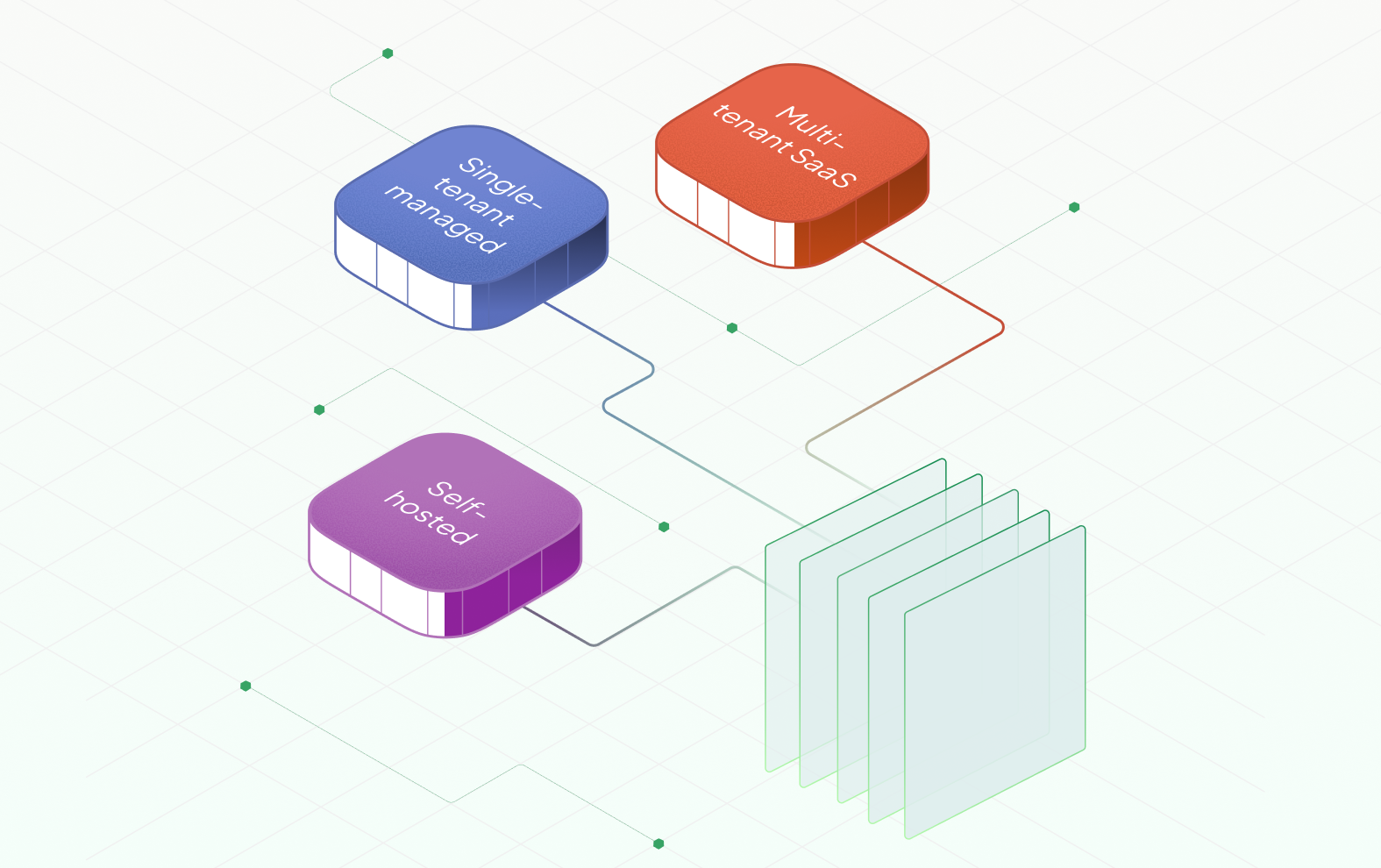
As products scale, analytics moves from being a dashboarding tool to becoming critical infrastructure. Performance expectations increase. Compliance reviews become stricter. Internal stakeholders demand reliability. At that point, the deployment architecture behind your analytics system starts to matter. Today, most product analytics platforms fall into one of three deployment models:
- Multi-Tenant SaaS
- Single-Tenant Managed
- Self-Hosted
Each model optimizes for different priorities. Understanding those tradeoffs early can prevent costly migrations or architectural friction later.
1. Multi-Tenant SaaS: Simplicity at Scale
This is the most common model in modern SaaS analytics. In a multi-tenant architecture:
- Multiple customers share compute clusters.
- Storage infrastructure is shared across tenants.
- Query workloads are balanced internally by the vendor.
- Infrastructure scaling is abstracted away from customers.
Why it became dominant
Multi-tenant SaaS optimizes for:
- Fast onboarding
- Minimal operational overhead
- Automatic scaling
- Lower barrier to entry
For early-stage startups or small teams, this model is often ideal. You get powerful analytics without thinking about infrastructure.
Where tradeoffs emerge
Because infrastructure is shared, the vendor must implement workload management systems:
- Query prioritization
- Resource throttling
- Tier-based limits
- Internal queueing
In most cases, these mechanisms work well. But as data volume and concurrency increase, performance can become dependent on vendor-level policies rather than purely on your own workload. This isn’t inherently bad — it’s a design tradeoff. Multi-tenancy optimizes for vendor efficiency and operational simplicity. It may sacrifice strict workload isolation.
Examples of multi-tenant SaaS analytics platforms include Mixpanel, Amplitude, and Heap.
2. Single-Tenant Managed: Isolation Without Operational Burden
Single-tenant managed deployments represent a middle ground. In this model:
- Each customer receives a dedicated analytics instance.
- Compute and storage are isolated.
- Infrastructure is still managed by the vendor.
- There is no shared query pool across customers.
This eliminates cross-tenant resource contention while preserving the operational simplicity of SaaS.
What this changes architecturally
Because infrastructure is isolated:
- Performance variability caused by other tenants is removed.
- Resource allocation is deterministic.
- Scaling decisions are instance-based rather than cluster-policy-based.
This model often appeals to growth-stage companies that:
- Are scaling rapidly
- Require predictable performance
- Sell into security-conscious industries
- Want infrastructure isolation without managing DevOps internally
It shifts the optimization model from vendor efficiency to customer isolation — without transferring operational responsibility.
Some analytics vendors offer single-tenant managed deployments, where each customer receives an isolated instance. For example, Countly provides this model through its Flex deployment option.
3. Self-Hosted: Maximum Control
Self-hosted deployments place the analytics system entirely within the customer’s infrastructure.In this model:
- Compute and storage run in your own cloud or on-prem environment.
- Scaling is fully controlled by your team.
- Security policies are fully customizable.
- Upgrades and maintenance are your responsibility.
Self-hosted analytics platforms include Countly (via Countly Enterprise), or Matomo.
Why enterprises choose this
Self-hosting is often selected when:
- Regulatory requirements demand full data control.
- Internal policies prohibit shared infrastructure.
- Custom security or networking configurations are required.
- Long-term infrastructure standardization is a priority.
The tradeoff is clear: You gain maximum control — but assume operational responsibility.
A Framework for Evaluating Deployment Models
Rather than evaluating deployment models emotionally (“shared is risky” or “self-hosting is complex”), it’s useful to compare them across objective architectural dimensions.
1. Infrastructure Isolation
2. Performance Predictability
3. Operational Responsibility
4. Compliance & Data Control
When Each Model Makes Sense
There is no universally “best” deployment model. The right choice depends on company stage, risk tolerance, and long-term architectural strategy.
Multi-Tenant SaaS is often ideal for:
- Early-stage startups
- Small teams with limited DevOps resources
- Organizations prioritizing speed over isolation
Single-Tenant Managed fits well when:
- Data volume is growing significantly
- Performance predictability becomes critical
- Security reviews are increasing in rigor
- Teams want isolation without operational burden
- (e.g., Countly Flex)
Self-Hosted is most appropriate when:
- Regulatory requirements mandate full control
- Enterprise customers demand strict isolation
- Infrastructure standardization is strategic
- Internal DevOps maturity is high
- (e.g., Countly Enterprise)
Why This Decision Matters Earlier Than You Think
Analytics systems are rarely migrated casually. Once deeply integrated into product workflows, dashboards, experimentation pipelines, and executive reporting, switching platforms becomes expensive and disruptive. That’s why deployment model decisions should be evaluated not only for present needs, but for:
- 2–3 year growth projections
- Regulatory exposure expansion
- Enterprise customer acquisition plans
- Increasing internal data usage
Choosing based purely on features can overlook infrastructure constraints that surface later.
The Bigger Picture
Product analytics is no longer just a dashboard tool. For many organizations, it is operational infrastructure. And infrastructure choices have architectural consequences.SaaS optimizes for simplicity. Single-tenant optimizes for isolation without operational burden. Self-hosted optimizes for full control. The right model depends not on what is fashionable, but on how your organization plans to grow.
Platforms that support multiple deployment models, like Countly, allow teams to start with SaaS, move to dedicated environments, or adopt self-hosting as requirements evolve—without switching tools.

Posts that our readers love


to grow your product
is here.