Self-Hosted vs Cloud Analytics for AI Data Pipelines: Privacy, Control and Cost

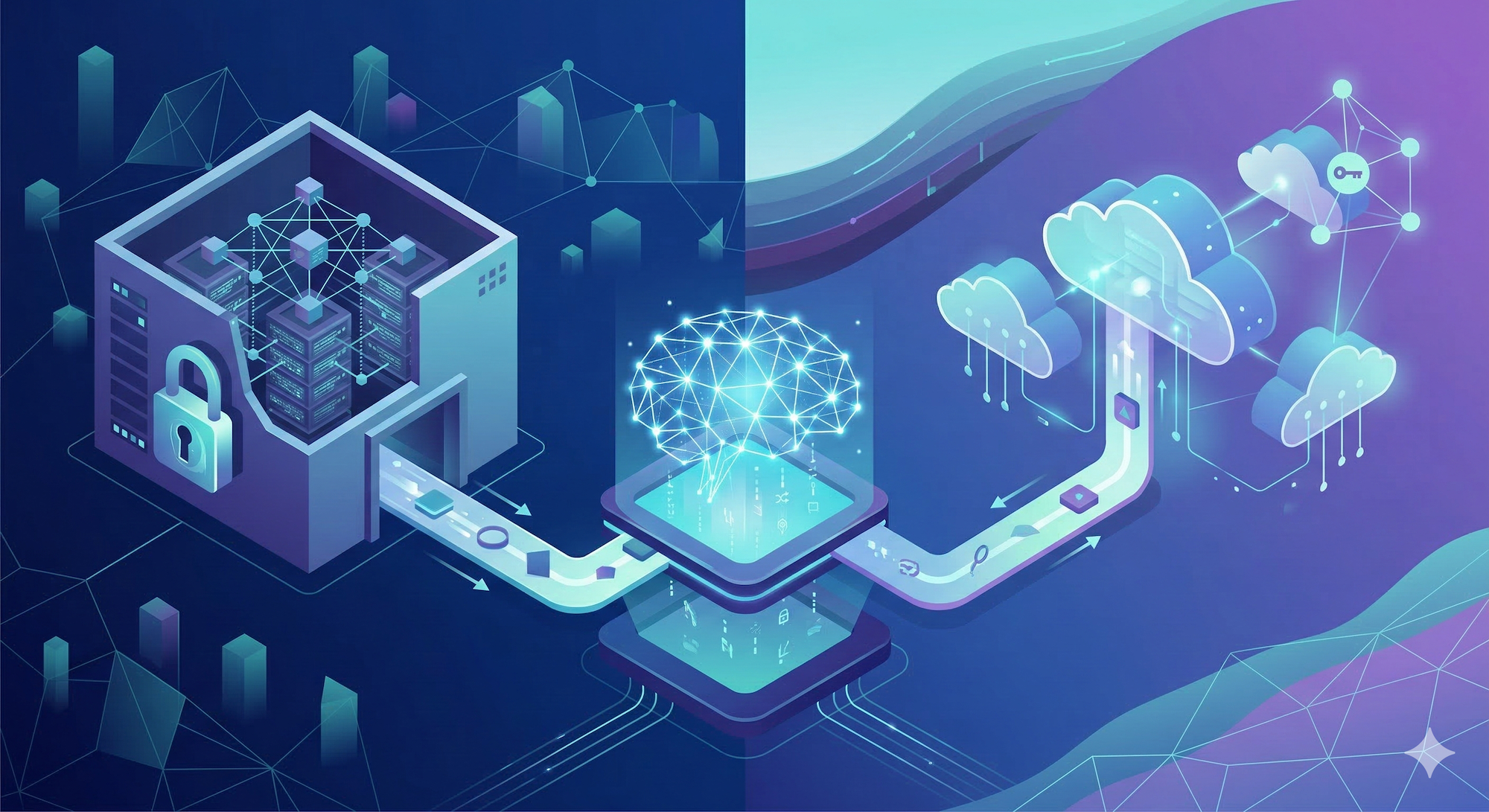
As AI and large language model deployments scale beyond proof-of-concept, the analytics infrastructure supporting them becomes a critical architectural decision. CTOs managing AI data pipelines face a fundamental choice: run analytics on their own infrastructure or route telemetry through third-party cloud services. This decision cascades into operational complexity, compliance exposure, and long-term cost structures that can make or break your AI initiative's unit economics.
The Privacy Calculus in AI Analytics
AI systems generate uniquely sensitive telemetry. Every prompt, completion, and model interaction contains potentially proprietary information about your training data, user behavior patterns, and competitive positioning. When this data flows to external analytics platforms, you're creating an attack surface that extends beyond your immediate control. Cloud analytics providers typically process data in multi-tenant environments where isolation guarantees are contractual rather than physical, and where data retention policies may conflict with internal governance requirements or customer commitments.
Self-hosted analytics platforms allow you to keep telemetry data within your existing security perimeter. This matters particularly for organizations operating under GDPR, HIPAA, or industry-specific regulations where data residency and processing location carry legal weight. According to IBM's 2024 Cost of a Data Breach Report, the average cost of a data breach reached $4.88 million, with AI and machine learning environments showing 15% higher breach costs due to the complexity of securing distributed systems. For AI companies handling customer data or training on proprietary corpora, a single analytics-related breach can eliminate years of margin.
The privacy advantage of self-hosted solutions extends to operational security as well. When your analytics stack runs on infrastructure you control, you can enforce the same security policies, access controls, and audit trails that govern your production AI systems. You eliminate the need to synchronize security postures across vendors, reduce the number of entities with access to sensitive data, and maintain complete visibility into who accessed what data and when. This consolidation of the security boundary simplifies compliance audits and reduces the cognitive overhead of maintaining multiple security models simultaneously.
Control Over Data Pipeline Architecture
Cloud analytics platforms optimize for ease of integration, which often means accepting their opinions about data modeling, retention, and query patterns. For AI workloads, this standardization creates friction. Model inference patterns don't map cleanly to traditional user session analytics, and the volume characteristics of AI telemetry differ substantially from web or mobile application data. You need the ability to capture high-cardinality dimensions like model version, prompt template, temperature settings, and token counts without hitting arbitrary limits or incurring per-event charges that make comprehensive instrumentation economically untenable.
Self-hosted analytics gives you full control over data schema evolution. As your AI systems mature, you'll discover new telemetry dimensions that matter for optimization, cost allocation, or quality monitoring. With self-hosted infrastructure, adding these dimensions is an engineering decision rather than a vendor negotiation. You can implement custom aggregation logic that aligns with how you think about model performance, build specialized retention policies that balance storage costs against analytical needs, and integrate directly with your existing data warehouse or lake without moving data across network boundaries multiple times.
The architectural control extends to query performance and customization. AI analytics often requires joining telemetry data with training metadata, user context, or external systems to answer questions about model behavior. Self-hosted platforms let you co-locate analytics data with related datasets, optimize query engines for your specific access patterns, and build custom visualizations or reporting tools that match your operational workflows. This flexibility becomes particularly valuable as your AI product matures and the questions you need to answer become more sophisticated than standard dashboard templates can accommodate.
Cost Structures and Economic Scaling
Cloud analytics pricing typically follows consumption models based on event volume, data storage, or monthly active users. For AI systems, these metrics create uncomfortable economics. A single user interaction with an LLM might generate dozens of telemetry events capturing prompt submission, streaming tokens, model selection, latency measurements, and error handling. As your AI product scales, analytics costs can grow faster than revenue if you're paying per-event to a cloud provider. The pricing model that works for traditional SaaS applications breaks down when event volumes are determined by model architecture decisions rather than user behavior.
Self-hosted analytics converts variable costs to fixed infrastructure costs. You pay for compute and storage capacity rather than individual events, which creates predictable cost structures as you scale. The initial capital investment in infrastructure and engineering time is higher, but the marginal cost of additional telemetry approaches zero once capacity is provisioned. For AI companies operating on tight unit economics, this difference can be substantial. A system generating 100 million analytics events monthly might cost $15,000-30,000 annually with a cloud provider versus $5,000-10,000 in infrastructure costs for a self-hosted deployment, with the gap widening as volumes increase.
The cost analysis must account for operational overhead. Self-hosted analytics requires engineering resources for deployment, maintenance, monitoring, and upgrades. You need expertise in database management, query optimization, and infrastructure scaling. However, for organizations already running sophisticated AI infrastructure, these skills likely exist in-house, and the incremental burden of managing an analytics platform may be smaller than the ongoing cost of cloud services. Platforms like Countly, Matomo, or Plausible offer self-hosted options with reasonable operational requirements, particularly when deployed on existing Kubernetes clusters or cloud infrastructure you're already managing.
Common Implementation Pitfalls
The most frequent mistake in deploying self-hosted analytics is underprovisioning for peak loads. AI systems can generate telemetry bursts that are difficult to predict, particularly during model training, batch inference jobs, or viral product moments. Your analytics infrastructure needs capacity headroom and buffering mechanisms to absorb traffic spikes without dropping data or degrading query performance. Implementing asynchronous event ingestion with queue-based buffering and auto-scaling compute layers prevents telemetry collection from becoming a bottleneck in your AI pipeline.
Another common error is neglecting the operational difference between collecting telemetry and making it actionable. Self-hosted analytics platforms give you all the data, but without thoughtful instrumentation design and dashboard construction, that data remains inert. Successful implementations start with clear questions: Which model variants perform best for which user segments? Where are we spending inference compute budget? What prompt patterns lead to safety filter triggers? Build your instrumentation and dashboards around these questions rather than capturing everything and hoping insights emerge. The flexibility of self-hosted solutions makes it easy to instrument everything, but focused instrumentation that aligns with business objectives delivers better returns than comprehensive data collection without clear purpose.
Strategic Considerations for AI-First Organizations
The analytics deployment decision reflects broader strategic choices about your technology stack's center of gravity. Organizations committed to building differentiated AI capabilities increasingly view data infrastructure as a competitive advantage rather than undifferentiated infrastructure. Self-hosted analytics aligns with this philosophy, treating telemetry data as a strategic asset that deserves the same architectural attention as training data or model artifacts. This approach creates compounding advantages as your analytics sophistication grows and you build custom tooling, models, or analysis workflows that would be impossible or impractical with cloud analytics services.
The hybrid middle ground deserves consideration as well. Some organizations run self-hosted analytics for production AI systems while using cloud services for internal tools or less sensitive applications. Others start with cloud analytics for speed to market, then migrate to self-hosted infrastructure as volumes scale and requirements clarify. The key is recognizing that the deployment model isn't permanent. Build abstraction layers in your instrumentation code that allow switching analytics backends without rewriting application logic. This flexibility lets you optimize the cost-control-privacy tradeoff as your business evolves, rather than being locked into early architectural decisions that may not serve your needs at scale.
Key Takeaways
•Self-hosted analytics keeps sensitive AI telemetry within your security perimeter, reducing compliance complexity and breach exposure while giving you full control over data residency and access policies.
•The cost structure of self-hosted platforms converts per-event charges to fixed infrastructure costs, offering better unit economics at scale for high-volume AI workloads that generate telemetry disproportionate to user counts.
•Architectural control over data schemas, retention policies, and query optimization becomes strategically important as your AI systems mature and require custom analysis that standard cloud platforms don't support efficiently.
•Successful self-hosted implementations require operational investment in infrastructure management and thoughtful instrumentation design focused on specific analytical questions rather than comprehensive but unfocused data collection.
FAQ
Q: How do I estimate the total cost of ownership for self-hosted analytics compared to cloud services?
A: Calculate the break-even point by projecting your monthly event volume and mapping it to cloud provider pricing, then compare against the fixed costs of infrastructure, storage, and engineering time for self-hosted deployment. Include costs for monitoring, backups, and disaster recovery in both scenarios. For most AI workloads generating over 10 million events monthly, self-hosted solutions show lower TCO within 12-18 months despite higher upfront investment.
Q: Can self-hosted analytics integrate with existing data science and BI tools?
A: Modern self-hosted platforms expose standard APIs and database interfaces that integrate with tools like Jupyter, Tableau, Looker, and data warehouses through direct connections or ETL pipelines. The integration effort is comparable to cloud analytics services and often simpler since data doesn't need to cross network boundaries. Choose platforms with well-documented APIs and active communities to ensure integration patterns exist for your specific toolchain.
Q: What happens to analytics data if we need to scale beyond a single server or region?
A: Self-hosted analytics platforms designed for production use support horizontal scaling through database sharding, read replicas, and distributed query engines. Geographic distribution typically involves deploying regional analytics clusters with optional data replication or federation depending on your latency and compliance requirements. The operational complexity increases with scale, but remains manageable with modern orchestration tools and cloud infrastructure primitives like managed databases or Kubernetes.
Sources
[IBM Cost of a Data Breach Report 2024](https://www.ibm.com/reports/data-breach)
[Countly Self-Hosted Analytics Platform](https://countly.com)
[GDPR Data Protection Requirements](https://gdpr.eu)

Posts that our readers love

to grow your product
is here.